

Opposition: Polarity, Projection, and Conscious Balance
Core meaning
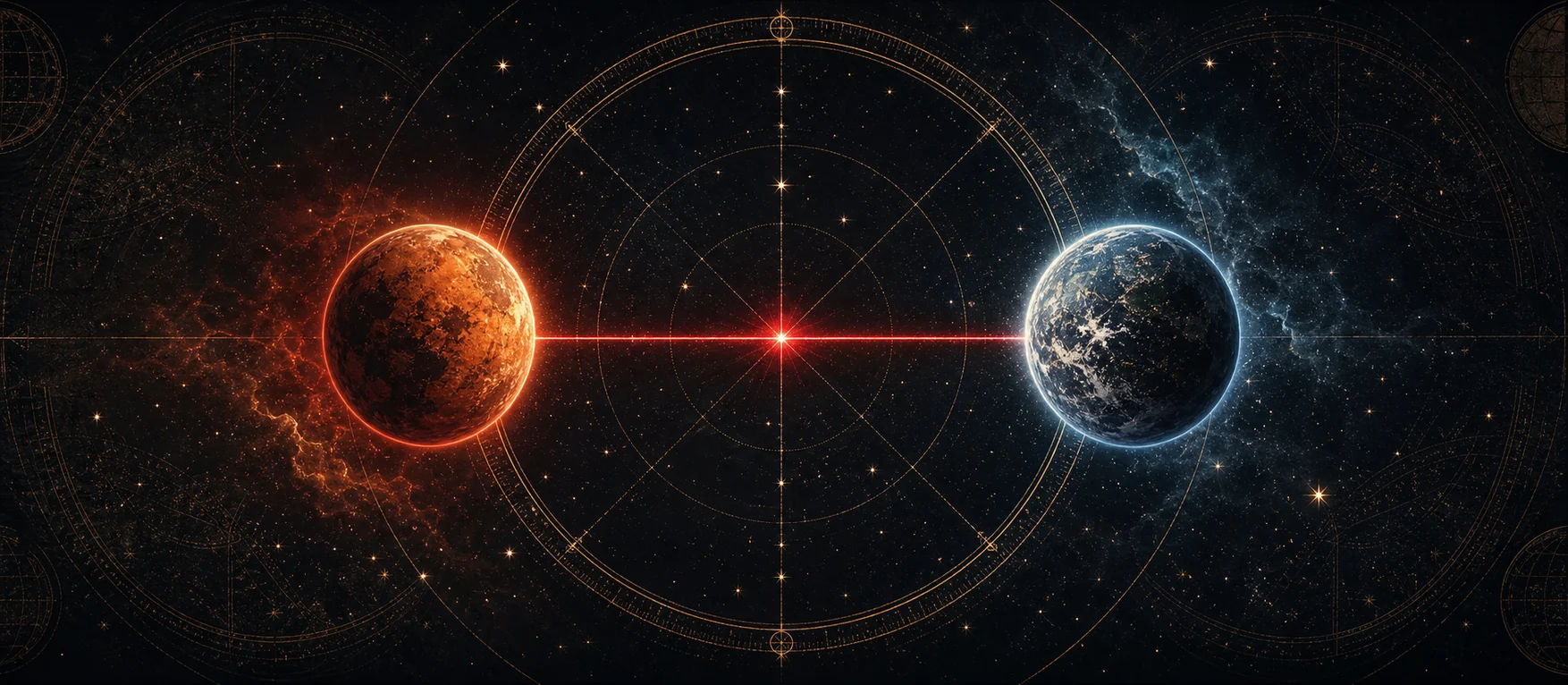
An opposition places two planets face to face, creating a polarity that often becomes visible through relationships, choices, or repeated situations. It is not only conflict: it is the need to recognize two forces that pull in different directions.
One planet may first be projected onto other people until the person learns to own both sides of the axis. Oppositions produce awareness because the tension is hard to ignore and usually appears through concrete encounters.
In interpretation, the opposition is a dynamic axis. The goal is not to erase one side, but to make both planets answer each other more consciously.
How to read it
The first layer is the two poles. Sun opposite Moon may split conscious direction from instinctive need. Mercury opposite Saturn may put speech, thought, or learning across from doubt, judgment, or responsibility. Venus opposite Uranus may set attachment against freedom.
The second layer is the life field where the opposition appears. A precise reading says what Mercury represents in its house and what Saturn represents in the other house, then translates that into concrete behavior: speech, work, family, partners, money, ambition, body language, public image. If one planet is angular, especially in the first or tenth house, that side of the conflict is usually easier for other people to perceive.
Oppositions are often mature aspects. They do not ask for a simple solution; they ask for a wider consciousness that can hold both planets without collapsing into one side.
Planet-pair examples
Sun opposite Moon can describe a life organized around polarity: public direction and private need, will and instinct, father and mother images, or two different rhythms of identity.
Mercury opposite Saturn can make language serious. The person may alternate between speaking and self-censoring, but the same tension can produce precision, authority, and careful thought.
Moon opposite Jupiter amplifies emotional life by contrast. Feeling may swing between private need and public reach, intimacy and excess, containment and generosity.
Celebrity examples

Kim Kardashian, the reality-TV and business figure known for social platforms, image control, beauty branding, and turning private life into public commerce, has the Moon opposite Jupiter, with Jupiter in the tenth house close to the Midheaven. The conflict is between the Moon in the third house, which can show family talk, siblings, everyday stories, and familiar emotion, and Jupiter in the tenth house, which shows fame, business reach, reputation, and public success. In practical terms, private family life and constant communication become a career, a brand, and a public spectacle.

Maya Angelou, the writer and activist known for teaching, travel, moral vision, and widening consciousness through culture, has Mars opposite Neptune, with Neptune in the first house close to the Rising sign. The conflict is between Neptune in the first house, which can show a sensitive, poetic, inspiring presence, and Mars in the seventh house, which shows direct confrontation, courage, opponents, and face-to-face conflict. In real life, the gentle or spiritual presence does not remove the fighting side: her voice could comfort, but it could also confront injustice directly.

Yuri Gagarin, the cosmonaut remembered as the first human in space and a symbol of crossing the normal limit of the world, has Mercury opposite Neptune, with Neptune in the tenth house. The conflict is between Mercury in the fourth house, which can show technical training, a practical mind, and private roots, and Neptune in the tenth house, which shows public idealization, heroic image, and collective dreams. In practical terms, the real pilot and technician becomes larger than life: a person with concrete skills is turned into a national and historical symbol.